
A KPI framework organises how an organisation measures and monitors performance — without it, metrics proliferate without purpose, creating metric sprawl, conflicting signals, and report overload. Not every metric qualifies as a KPI: “key” means tied to strategic objectives, actionable, quantifiable, and time-bound. Organisations should maintain 15-20 KPIs maximum — if everything is key, nothing is. The framework must balance leading indicators that predict future outcomes with lagging indicators that confirm them, structured hierarchically from strategic (board-level, quarterly) through tactical (management, monthly) to operational (team-level, weekly or daily). Every KPI needs a clear owner, defined calculation method, explicit target, and measurement cadence. Structure comes before metrics: the framework prevents conflicting signals and ensures each indicator serves a clear role in understanding and improving business performance.
Purpose & Context
A KPI framework organises how an organisation measures and monitors performance. Without structure, KPIs proliferate without purpose. With a framework, every metric serves a clear role in understanding and improving business performance.
This article provides guidance for finance leaders designing or refining their organisation’s KPI system.
Definition
A KPI (Key Performance Indicator) is a quantifiable measure that demonstrates how effectively an organisation is achieving key business objectives.
The “key” is critical: not every metric is a KPI. KPIs are:
- Tied to strategic objectives: They measure what matters most
- Actionable: Performance against them can be influenced
- Quantifiable: They have clear calculation methods
- Time-bound: They are measured at regular intervals
A KPI framework organises these indicators into a coherent system.
Why This Matters
Organisations without a KPI framework face predictable problems:
- Metric sprawl: Hundreds of measures with no clear priority
- Conflicting signals: Different metrics suggest opposite actions
- Gaming: People optimise for measured indicators regardless of real impact
- Report overload: More data, less insight
A well-designed framework solves these problems by providing structure and purpose.
Key Components
Strategic Alignment
Start with business objectives:
- What are the organisation’s top 3-5 strategic priorities?
- What would indicate progress toward each priority?
- How would we know if we were off track?
Hierarchical Structure
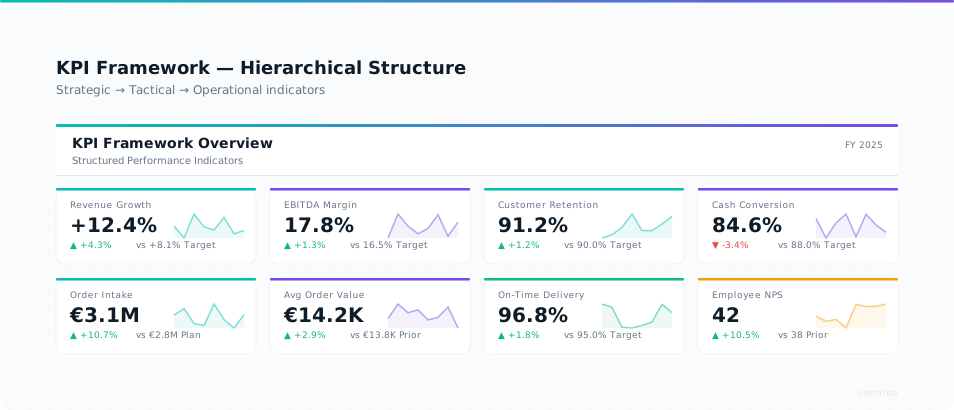
Organise KPIs from strategic to operational:
- Strategic KPIs: Board-level, quarterly focus
- Tactical KPIs: Management-level, monthly focus
- Operational KPIs: Team-level, weekly or daily focus
Each level should cascade logically: operational KPIs aggregate into tactical, which support strategic.
Balanced Perspectives
Cover multiple dimensions:
Customer
Satisfaction, retention, acquisition — signals whether value is being delivered
Experience
Operational
Efficiency, quality, cycle time — shows how well the business executes
Execution
People
Engagement, capability, capacity — indicates whether the organisation can sustain performance
Capability
Every KPI needs an owner, a defined calculation method, a target, and a measurement cadence — the framework is only as strong as its governance
- Financial: Revenue, margin, cash flow
- Customer: Satisfaction, retention, acquisition
- Operational: Efficiency, quality, cycle time
- People: Engagement, capability, capacity
Clear Ownership
Every KPI needs:
- A definition (exact calculation method)
- An owner (who is accountable)
- A target (what good looks like)
- A cadence (how often measured)
Designing Effective KPIs
The SMART Criteria
Each KPI should be:
- Specific: Clearly defined, no ambiguity
- Measurable: Quantifiable with available data
- Achievable: Realistic targets
- Relevant: Connected to strategic objectives
- Time-bound: Measured at defined intervals
Leading vs. Lagging
Balance indicator types:
- Lagging indicators: Measure results (revenue, profit)
- Leading indicators: Predict future results (pipeline, customer satisfaction)
Leading indicators enable proactive management; lagging indicators confirm outcomes.
Avoid Common Traps
- Too many KPIs: If everything is key, nothing is
- Vanity metrics: Numbers that look good but don’t inform decisions
- Easy-to-measure over important: Don’t ignore what matters because it’s hard to track
- Static frameworks: KPIs should evolve as strategy evolves
Where This Fits in Our Expertise
KPI frameworks are a core component of the Reporting pillar . They determine what gets measured, which in turn determines what gets managed.
Without clear KPIs, dashboards become data displays. With a framework, they become decision tools.
Summary
- KPIs are “key” - not every metric qualifies
- Framework before metrics: structure enables meaning
- Balance leading and lagging indicators
- Every KPI needs an owner, target, and cadence
- Less is more: 15-20 KPIs maximum for most organisations
Further Reading
- Management Reporting Framework - Structural foundation for reporting
- Reporting Expertise - Our approach to management reporting
- Glossary: KPI - Term definition